
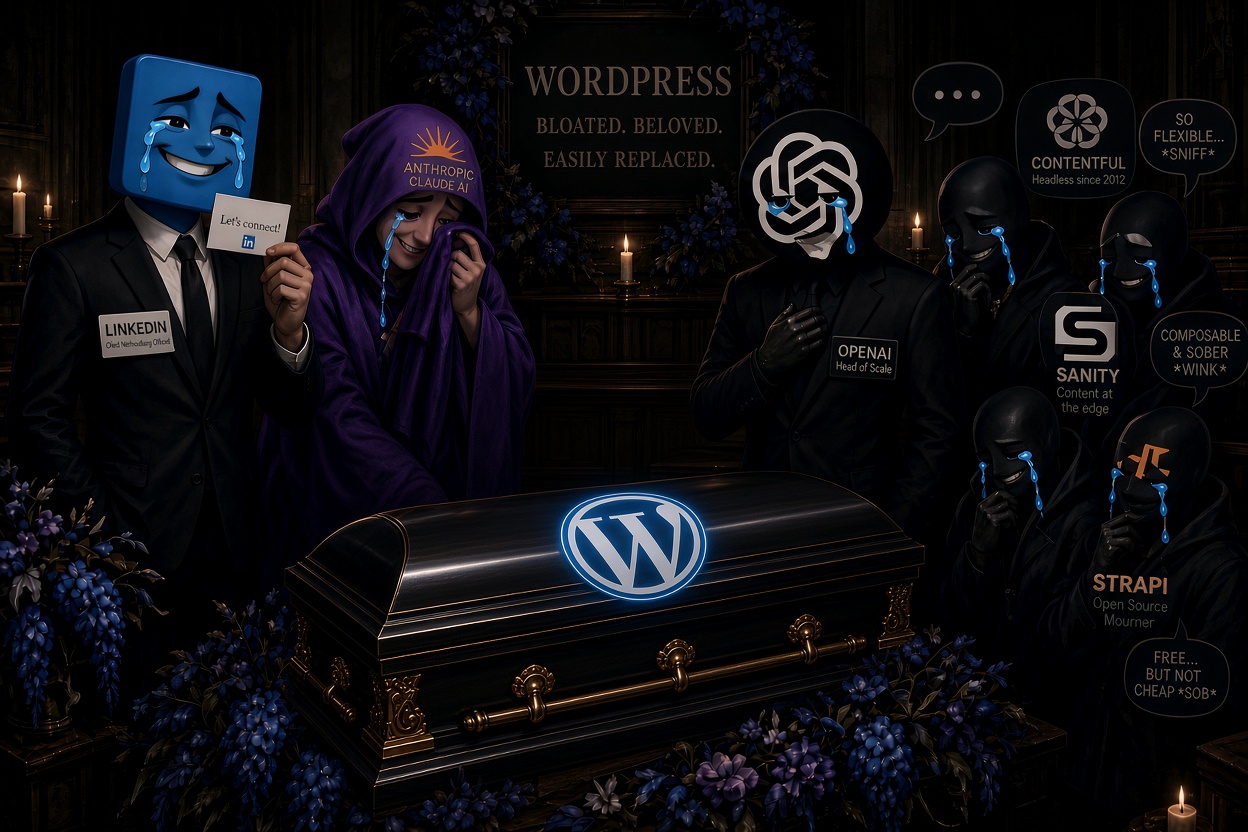
Before we go any further
I’ve been a WordPress developer for as long as there’s been a WordPress to write about. I like that it’s flexible, extensible, and can quickly turn bad ideas into a solid framework, and not just for my own sites, but for others’ too.
I am not a fanboy. I have issues with WordPress and its decisions, past and present. But I won’t fork WordPress into PressWord just because I disagree with something.
With that said, let’s start.
In this article
- The numbers
- The AI site builder
- So is AI the enemy?
- The headless crowd
- Is it Shopify?
- Gutenberg
- Is it PHP?
- Is it security?
- Is WordPress fragile?
- Three hundred sites later
- The one that got away
- The real point
- The cynic’s answer
Last Thursday
Ever since I started caring about my LinkedIn feed (last Thursday, if you’re interested), the “WordPress is Dead” posts have been getting more annoying by the day.
Most of it falls into one of two camps. Either it’s a transparent attempt to sell a new system someone came up with recently (busy day, it appears), which they think is the latest and greatest, so they’re trying to sell it! The replies defending it? Usually someone selling professional WordPress services.
I don’t fit into either camp. I’m not selling anything. I just have a really sensitive bullshit detection kit, and it’s activated. Not deactivated. Yet.
See what I did there? A small WordPress joke. I can be funny too!
So why do people think it’s dead?
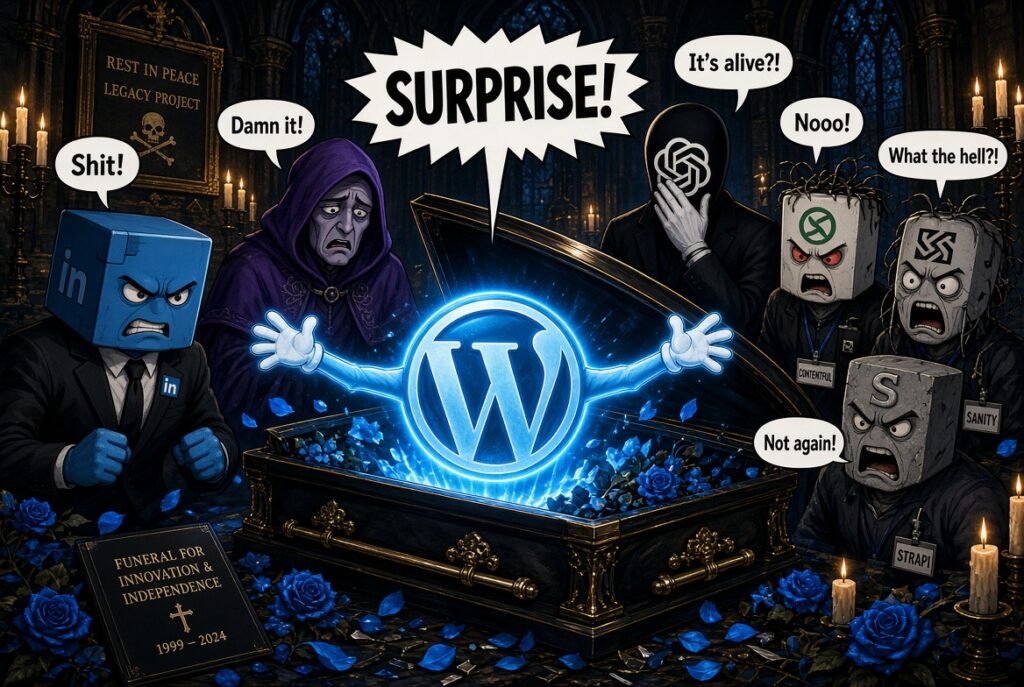
Why do people think a content management system more than two decades in the making is dead?
Is it an age thing?
Probably not. Microsoft Windows has been going since 1985 and no one’s writing its obituary on LinkedIn. (And to those who claim “this is the year of the Linux desktop”, you can go away. It never has been and never will be.)
Age is actually the point. Two decades of real websites, run by real people, doing things nobody planned for. Every weird edge case, odd server setup, and client who pasted their entire homepage from Word: someone’s already encountered it, reported it, and had it fixed. Most WordPress core bugs were found years ago by other people on their websites.
Anything invented recently hasn’t had its bad days yet. Those days are still coming. And when they do come, you’ll be the one to find them.
The numbers
WordPress’ market share has dropped. W3Techs reports a 1.3 percentage point drop over six months, to around 41% of all websites by May, and that’s where it’s at now. But this isn’t so scary when you see who’s in second place, Shopify, with its ecommerce focus, is at about 5%. Wix is third with about 4%. Among sites that run a content management system at all, WordPress still accounts for roughly 59% of them.
Losing two percent of your weight doesn’t mean you’re dead.
So where did that share go? It didn’t go to Shopify, Wix, or the latest thing from last Thursday. It went, as far as anyone can tell, to sites with no detectable CMS at all: hand-coded pages, static site generators, headless setups and AI-generated sites.
What nobody can tell you is why, or what those sites are. Static landing pages that never needed a CMS in the first place? Or perhaps brochure sites thrown together in an afternoon. And there’s no data on this.
But here’s something the stats miss. I helped create a WordPress landing page builder that exports static sites. These pages lived on the same hosting as the client’s WordPress install, were built with WordPress, and managed through WordPress. To W3Techs, each one looks like a site with no CMS. So some of that “decline” may be WordPress building sites that don’t look like WordPress.
And a falling percentage doesn’t mean a falling number. If the web is exploding with quick, disposable, AI-built pages, WordPress’ slice of the pie shrinks even if its sites don’t go anywhere. That’s not a drop. That’s a bigger pie.
Either way, as a developer I’m not losing sleep over it. Market share is the marketing department’s problem. My problem is whether the contact form honestly works, though.
The AI site builder
This is probably where a good chunk of that “no CMS” growth comes from, and I’ve watched it happen up close.
Just as 2026 rolled around, the agency I worked at started using AI to build landing pages. The sales pitch is simple: describe the page, get it, bill the client, and you’re done. But what I saw was designers struggling with multiple prompts to get just one page from the AI. A single page. That effort that went into coaxing it into shape would have built the page in WordPress, with change to spare.
Once the page was live, the client wanted to swap a photo. Or change a word. You know who they came to? Not the designers, to recreate it. That’s for sure.
But no, It was me instead. I had to reconnect it to analytics, set up the contact form, and handle the data, because the designers didn’t know about the work that went into making it all work.
But AI evangelists never talk about this part. AI is great at creating the front end of a website, the part users see. But most of a website is the back end, which includes things like form handling, email notifications, data storage, GDPR compliance, tracking, and updating contact information. A CMS exists precisely so that swapping a photo doesn’t mean calling a developer.
AI builders are likely taking over the low end of the market, which includes simple brochure sites that used to be built with free WordPress themes. WordPress never made its money from those sites anyway. And every one of them honestly shows up in the stats as a site with no CMS, right up until somebody needs to change it.
But when that day comes, ask yourself: do you really own the site? Many cheap AI builders host your site on their platform, under their terms. If you can even export the site, you’ll usually get a pile of generated code with no admin interface and no documentation. Want to move? You’re not moving. You’re starting again. Want help? Where’s the support? A chatbot, a help page, and a ticket queue that answers in three to five working days.
So is AI the enemy?
No, WordPress loves AI. It has folded AI connectors directly into WordPress itself. As of version 7.0, a Connectors screen is available in the settings; you add your AI provider once, and any plugin can use it. It’s new, and I’m genuinely interested to see where the community takes it.
And here’s the bit I like best. WordPress doesn’t tie you to one AI company. You choose the provider, plug in your key, and can switch if needed. No lock-in. This is the same principle as the rest of WordPress; it’s your site, your choice.
I also love AI, I’ll be upfront about it: this site has had a lot of AI assistance, mostly the images, but also articles like this one, which need structure and a sanity check. The child theme I’m running, with all the code I’ve added over the years, has been through Claude to check for security gaps. I might have twenty years of experience, but a second pair of eyes that never gets bored of reading my code is worth having.
So, wait, didn’t I just spend a whole section having a go at AI?
Not exactly, The difference is who’s using it. When used by someone who knows what they’re doing, AI is a brilliant tool; it spots what you missed, asks questions you didn’t think of, and you can check its work because you know what good looks like. But using AI instead of someone knowledgeable can result in a gorgeous landing page that isn’t connected to anything, and a developer being asked to make unnecessary changes.
AI won’t kill WordPress. WordPress is actually making itself one of the easiest places to use AI. The thing that’s in trouble is the idea that you don’t need to understand what you’re building.
The headless crowd
This isn’t my area, so I’ll be fair about it, because this lot actually deserve some fairness.
The term ‘headless’ refers to splitting a website into two parts. The back end, where content is written and stored, becomes one system. The front end, what visitors see, becomes a completely separate one, built using a modern JavaScript framework, and they communicate through an API. Tools such as Sanity, Payload, and Storyblok manage the content side; and frameworks like Astro and Next.js build the front end. (You’ll also hear “Jamstack”, which is the same broad idea with a slightly more hipster haircut.)
And they’re genuinely good. They’re fast, they’re secure, developers enjoy working with them, and the editing experience has improved over the past few years. They’re winning briefs, particularly developer-led marketing sites, that a few years ago would have gone to WordPress without a second thought.
Good. Competition is healthy. It keeps WordPress honest, and it encouraged WordPress to develop the block editor.
But notice who these tools are for: teams that have developers at their disposal. That front end is custom code, so there’s no theme to install and no plugin directory to raid. Want a new feature? That’s a developer. Want the site to look different? That’s a developer. For a company with an in-house dev team, that’s a perfectly sensible trade. For a local plumber with a website and a contact form, it’s a bill.
And here’s the joke the “WordPress is dead” posts never get. WordPress can also be used in a headless setup. It’s had a built-in REST API since 2016, and many of those modern decoupled sites have WordPress working behind the scenes, handling content management, while a modern framework handles the front end. To the market share surveys, that counts as “not WordPress” too.
Being the thing behind the thing isn’t dying. It’s what infrastructure looks like.
Is it Shopify?
This number two in that market share table is? Shopify. It’s the alternative people reach for and it’s purely an ecommerce platform. WordPress has its own answer: WooCommerce, a free plugin that runs on WordPress and turns it into a full online shop. And it’s no small player. Roughly three in ten online shops run on it.
I’ve worked with both, and I’ll be honest about it.
For a small shop with a handful of products, go with Shopify. It’s quick to set up, it’s polished, and you’ll be taking orders by teatime.
If you’ve got a large catalogue, or you need something Shopify doesn’t do out of the box, go with WooCommerce. A customised checkout. Layouts built around your products and your business rather than someone else’s template. On Shopify, some of that pretty means paying for Shopify Plus, the expensive enterprise tier. With WooCommerce, you’ll need to write some code.
To me, Shopify is rigid: the page layout is set. WooCommerce is more like giving you a base. You can do what you like with it. I’m here if you need me.
But WooCommerce isn’t perfect. It’s a beast. It can be clunky, it can be slow, and yes, it has its own vulnerabilities. This difference lies in who handles them. Shopify patches its platform on its servers, and you pay for the service. You patch WooCommerce yourself. There are updates. And there are many updates. It’s the same trade-off as the rest of WordPress: you own it, so you’re responsible for it.
I’ve built and maintained WooCommerce sites with 10,000 products, multiple variations on every one of them, and custom code throughout. It handled them. It needed maintenance, but it handled them.
And to make it clear: all of that’s running on WordPress. The supposedly dead CMS is quietly powering a large part of the world’s online shops.
Gutenberg
Gutenberg. Gutenberg.
I can understand the logic behind it. WordPress was born to handle blog posts and walls of text, and the classic editor was great for that. Layouts were a different story, though. Those who tried to get two columns side by side in the classic editor know how frustrating it was. A change was needed.
WordPress 5.0 changed it in late 2018. I wasn’t impressed.
Clients weren’t fans either. They’d log in, see a screen full of blocks where their familiar editor used to be, and ring me. So we did what made sense: swapped it out for WP Bakery, and things went back to normal. Clients got drag-and-drop, I got my evenings back, and no one had to learn anything new.
The block editor has come a long way since then. Building custom blocks with ACF is actually quite pleasant. It gives clients the fields they need, without anything they can break. But clients still preferred WP Bakery. Or Elementor. Or whatever third-party page builder the last agency had chucked on their site.
Page builders have a downside, though. Switch WP Bakery off, and your homepage becomes a mess of shortcodes. That’s not a dig at the tools. It’s just the price of the convenience, and every developer who’s inherited a site has paid it.
But the ‘WordPress is dead’ crowd misses a key point. Gutenberg is their main example: WordPress made an unpopular decision, and users didn’t like it. What actually happened was. Users didn’t like the new editor, so they installed a different one and kept going. The Classic Editor plugin has been one of the most popular plugins since then.
A platform where you can rip out the core editing experience and replace it with someone else’s, without leaving the platform, isn’t a platform on its deathbed. That’s the flexibility I was banging on about at the start. You don’t have to agree with every decision WordPress makes. You can just install a plugin instead.
Is it PHP?
Let’s be honest: PHP was never fashionable. It was never the cool kid on the block. It showed up in the wrong shoes, yet ended up running the sound system all night.
CGI and Perl come to mind; PHP stole the show, and the hardcore Perl crowd never got over it. It allowed hackers to drop code into an HTML page, and it just worked, no fuss. Purists hated it because it was easy, but that’s what everyone else loved about it.
And they had a point, for a while. PHP took its time to mature. That early versions were a glorious mess of inconsistent function names, security footguns and a register_globals setting that we don’t talk about. It earned its share of jokes.
But that’s history now. PHP 7 roughly doubled its speed overnight, and the 8.x releases have turned it into a genuinely modern language: proper types, named arguments, enums, match expressions, a JIT compiler. PHP today bears about as much resemblance to PHP ten years ago as a modern hatchback does to a Ford Cortina. Same name, different story.
That thing is, A marketing firm in Cleethorpes doesn’t care about those details. They don’t care about type systems or JIT compilers, and they certainly don’t care what PHP was like in 2006. They want a website that works, that they can update themselves, and that will still be running and supported in five years’ time. They’re not interested in developers bickering over “my language is better than yours because of… reasons.”
The “PHP is dead” argument is the “WordPress is dead” argument’s older brother, and it’s been wrong for even longer. The client’s question remains: will it last, and can someone fix it? PHP and WordPress offer a reliably dull yes. Most businesses want exactly that from their website: reliability.
Is it security?
Saying “WordPress is insecure” gets a reaction. It’s either a crowd pleaser or alarmist, depending on your perspective. Patchstack, a company that specializes in WordPress security and releases an annual report, has some actual numbers to consider.
- 11,334 new vulnerabilities were found in the WordPress ecosystem in 2025, up 42% on the year before.
- 46% of them had no patch available when they were made public.
- For the heavily targeted ones, the median time from disclosure to someone actively exploiting it was five hours.
Nothing will scare you if that doesn’t. Five hours. Meanwhile, somewhere out there, a site owner is watching the updates counter in the admin bar creep up for the fourth month running and thinking, “Must get round to that.”
Things are scary. But before you all rush off to a consultancy trying to sell you a bank vault of a CMS they wrote last Wednesday (jeez, last week was busy), look at this number:
- 91% of those vulnerabilities were in plugins. 9% were in themes. Six were in WordPress core, and all six were low priority.
Six. Out of eleven thousand.
WordPress core is solid. What goes wrong is what gets bolted onto it: the plugin that hasn’t been touched since 2019, the premium theme bought from a marketplace and never updated, the “free” add-on from a developer who’s since moved on to other things. This is the neglect list.
When something turns up in core, WordPress does what it always does. Security researchers and Joe Public say, “Look, WordPress, this is broken, and here’s how you exploit it,” and a minor release comes out with the fix. For over a decade, minor versions have updated themselves automatically. Plugins can update themselves too, if you let them. The tools are there. Somebody just has to switch them on.
This isn’t unique to WordPress. Search any vulnerability database for Joomla, Drupal or even Shopify and you’ll find plenty. Shopify’s advantage is that it’s hosted software: they patch it once, on their servers, and nobody has to remember to click anything. Which is lovely, right up until the rent goes up.
So here’s my question for the people selling the alternative. Do you really think your own little headless CMS, or the one your AI knocked up over a weekend, is 100% bulletproof? Secure like Fort Knox?
No reported vulnerabilities doesn’t mean none exist. This usually means nobody has looked yet. Everybody looks at WordPress: researchers, bug bounty hunters, hosting companies, and the bad guys. Each hole found gets fixed. A bespoke CMS with forty users doesn’t get scrutinized. It gets found out later, and usually by the wrong person.
And AI-built code? Patchstack’s own report specifically warns about “vibe coding”: developers using AI to generate code and shipping it without being able to check what the model actually wrote. The security people are already worried about it. So am I, and I’ve seen the prompts.
Is WordPress fragile?
Yes. It is.
Things go wrong without love and care, just like a house. It’s all the same, whether it’s kids, a car, or a house, they all need regular maintenance. I think of it like a house with a Cortina on the drive, both requiring attention to survive, and neither does well if ignored.
But tell me Joomla doesn’t have the same problem. Or Drupal. Or ModX. Or Craft. Tell me that an update to one of the four hundred npm packages your shiny JavaScript front end depends on is absolutely, guaranteed stable. In 2016, one developer pulled an eleven-line package called left-pad from npm and broke build pipelines across half the internet. Eleven lines. Don’t talk to me about WordPress being fragile.
Websites typically fall apart in similar ways, with outdated plugins, abandoned themes, and developers who moved on years ago, like that one who left in 2021. Also, hosting accounts often get neglected, sometimes since as far back as 2019, because login credentials were never shared with anyone.
That’s not a WordPress problem. That’s a nobody-was-looking-after-it problem. Leave any CMS alone for five years and see what you come back to.
Three hundred sites later
So let’s talk about longevity. Mine, and WordPress’.
At an agency, I worked with over 300 client sites spread across four shared hosting servers, mostly cPanel with some SiteGround thrown in. They were a mix of Joomla and WordPress, and I maintained the lot, partly because nobody else could be bothered and partly because I enjoyed it. You could call it masochism.
I sent out updates once a week. And if a critical vulnerability came up, I patched it that day. What can I say, I’m obsessive about these things. A client’s website is their window on the world, their shop front, and in some cases their living. If one went down because of a vulnerability I could have patched, that would be ten times the pain of clicking Update and sitting through five seconds of maintenance mode. Call it empathy. Call it not wanting that phone call. Same thing, really.
And that’s the security section in a nutshell. I kept 300 sites patched, every week, for years. You can manage that with one site.
But here’s the bit that matters. In seven and a half years of working on, patching, bodging, hacking and rewriting WordPress code, not one client ever said, “WordPress sucks, can we move to Joomla?”
Not a single one.
However, we did get ‘Joomla sucks, what do you recommend’ more than once.
Bear in mind we worked mostly with charities and non-profits, where money is tight and a rebuild is a hard decision. No one was scared into it by ‘Joomla is dead’ posts, and no one was sold expensive replatforming packages. They asked because their site was causing them problems. So we rebuilt their Joomla sites in WordPress, using an exporter I wrote.
We then trained them. Here’s what’s different. Here are your posts, here are your pages. This is how to add, edit, and delete content. That was about it. They went back to running their charity, and the website was no longer a problem.
Everyone was happy. We were even thanked, they were so happy. If you’ve worked in an agency, you know how rare that is.
That’s what longevity looks like. Not a fashionable technology, but one that works, so the client stops thinking about the website.
The one that got away
I have a story that goes the other way.
A client came to us wanting a membership journey. The project was exciting, involving various APIs, customer location. And membership level choices, and a simple payment process. It seemed easy, and I was already thinking it through during meetings.
However, the project was assigned to a new hire. He was technically brilliant, far ahead of the rest of us. But, also, nobody instructed him to work within the WordPress framework.
We caught up a few weeks later. It worked flawlessly; that was great. Can we’ve a look at the code? He sent over the GitHub repo.
That code was written in Laravel.
Between the rest of us, a team hired specifically for WordPress development, our combined knowledge of Laravel ranged from zero to fuck all.
After a mild panic, we told ourselves: OK, OK, we can do this. We would put it live and figure things out later.
The developer then left.
Support tickets started coming in.
The developer became unreachable at that point.
We then had to explain to the client why we couldn’t make requested changes, since nobody in the building knew how to maintain what they had paid for.
This is not a criticism of Laravel. Laravel is a good framework, and it would have been a sensible choice with the right team. The developer wasn’t really at fault; nobody had told him. The issue was the client’s website now relied on one person, who was no longer available.
Now, consider replacing the new hire with an AI. The story is the same, but faster. Code that works perfectly from the start, written by something that won’t be available to answer support calls, and in a way nobody else has seen.
The real point
The thing that saves you when a WordPress site goes wrong: twenty years of mistakes made by others, all documented.
Whatever’s broken on your site, someone broke it first, probably in 2011. They asked about it on Stack Overflow, a support forum or a blog and got three answers, two of them correct. A targeted search and you’re usually fixed before the kettle’s boiled. The documentation and code are open, and the community has spent two decades patiently, and sometimes less patiently, answering the same questions.
Try that with certain other platforms I could mention, where the useful information is locked behind a partner login, a paid Slack channel and a secret handshake. Developers only. Shhh. Very hush. Not for your eyes.
And it’s not just the answers. It’s the people. If your WordPress developer disappears, you can find another one in almost any town, and they’ll know their way around your site by the end of the week. Try finding someone to take over a one-off system that only its author understood. Or, worse, one that nobody wrote at all.
That’s what “future-proof” actually kind of means. Not the newest technology, but the one where, when something breaks at 4pm on a Friday, you can find the answer, and find someone to fix it.
The cynic’s answer
So we’ve been through the numbers, the AI builders, the headless crowd, Shopify, Gutenberg, PHP and security. None of these add up to a corpse. Why does the “WordPress is dead” post keep turning up in my feed like a bad penny?
Put the kettle on. My bullshit detection kit is fully activated and I’m not afraid to use it.
Follow the money
The oldest question in the book is, who benefits?
In almost any “WordPress is dead” post, a link is at the bottom. A demo. A free trial. A “DM me to find out how we helped a client migrate”. The obituary serves as an advert. The funeral comes with a gift shop, which is the real point.
Nobody writes “WordPress is fine, carry on” on LinkedIn, since there’s no payment for it. That sentence doesn’t have a product at the end. “WordPress is dead” is only half a sentence.
Rent, don’t own
What really gets me. WordPress is open source. You can download it free, install it on any hosting you like, move it whenever you want. And no one can switch it off or raise the price; it won’t get acquired and discontinued. The site is yours.
Many alternatives are software as a service. They’ve a nice product and interface, but you’ll pay monthly, per seat, per site, per API call. Your content is on their servers, in their format, under their terms. If they double the price, get acquired, or go out of business, you’ll have a hard time exporting your content.
A subscription business wants you to leave WordPress. If you own your site, you don’t pay rent.
People who have been around a while remember domain slamming: the official-looking renewal notice that was actually a transfer form, which resulted in your domain being transferred to a registrar that charged three times more. No one is accusing today’s platforms of doing anything that underhanded. But some of what’s being sold on LinkedIn is similar. Your content, your design, your customers, all locked away on someone else’s servers, in someone else’s format. It’s all fine, right up until the service goes downhill and you want to leave. Then you’ll have to pay a lot to get your site back.
Leaving WordPress only costs you a zip file and some time.
I’ve seen what the alternative looks like. We once took on a new client and inherited their sites, which used the hosting company’s custom CMS. And that was clear. It was very restricted. I mean really locked down. You could change the content, but only within a very limited structure.
The client wanted Trustpilot reviews in the footer of their site. In WordPress, that’s straightforward: just add a widget or hook, and you’re done in a few minutes. But not in this CMS. And their support was limited. The support link on their site was the same color as the background and very small. It was essentially invisible.
Every week, we had to tell the client that the CMS didn’t allow what they requested. And every week, the account managers would add something like, “Of course, if it were WordPress, we could…”
I know. That’s angling for a sale, and I’m about to have a go at the migration industry. The difference is that this client didn’t need to be scared. They’d spent months being told “no” by their own website. They didn’t need a LinkedIn post to realize something was wrong.
They eventually switched to WordPress. And our relationship improved, because we could then say ‘yes’.
The migration industry
The platforms aren’t the only issue. Somebody has to move you. Replatforming is a pretty lucrative project: discovery workshops, content audits, a new design, a new build, a training day and a support retainer at the end of it. You can’t convince a client with a working website to buy in. First, they need to be convinced their site isn’t working.
A ‘WordPress is dead’ message is like a scary bank letter. Its purpose isn’t to inform. It’s there to make you nervous enough to ring someone.
The engagement farm
And then there’s LinkedIn and the tech market. Tech is always on the lookout for the next big thing: something new to grab the attention of people with short attention spans. This algorithm also feeds on this. Being right doesn’t get rewarded. But getting noticed does. “WordPress is a mature and widely used platform with some real challenges” might get you three likes, including one from your mum. But ‘WordPress is dead’ gets hundreds of comments gets you hundreds of comments, most of them from angry WordPress developers.
Which, yes, I’m aware, makes this article part of the problem. I accept that.
The ‘X is dead’ hook is an old one in tech writing. Email, the web, SEO, blogging, and PHP have all been declared dead. All of them have been declared dead more times than a soap opera villain, yet they’re all still around, paying mortgages.
Fear sells
What these posts are really selling is fear, when you strip it all back. WordPress is dead? We’ve got to move now.
This is the same old trick that sells everything else:
- Ageing is bad, so buy our expensive cream once a month.
- Protect your family from home invasions with our service. Only £X per month.
- Release the equity in your home before it’s too late.
- Make your towels soft enough for your baby; you do love your baby, don’t you?
Many of those end in ‘per month’? Fear gets you in, and the subscription keeps you there.
This is common and transparent, yet people fall for it every day.
What real death looks like
What does a genuinely dead technology look like? Look at Flash. Flash died on a specific date. Adobe announced it years ahead, the browsers pulled support, and on the last day of 2020 it was switched off. No ambiguity, no LinkedIn discussion needed.
A real death comes with a notice. WordPress still releases updates, WordCamps are well attended, the plugin directory is growing, and agencies are hiring. That’s not a death rattle. That’s a pulse.
Check their source
Here’s a fun game for a rainy afternoon. Next time you’re told WordPress is dead, check the company website’s source code for wp-content.
You won’t find it every time. But you’ll find it more often than expected.
In fairness
These posts aren’t all sales pitches in disguise. Some people have had genuinely bad experiences with WordPress: sites that are bloated with 60 plugins, a theme from 2014, or hacks that take a weekend to clean up. Their frustration is real. But that’s usually a story about how a site was built and maintained, not about the platform. A terrible house can be built with good bricks.
WordPress has also earned some criticism. The fight between WP Engine and Automattic did not help the project’s reputation. Gutenberg’s rollout was clumsy. I would make some decisions differently.
Last Thursday (again)
Here’s the thing the “WordPress is dead” crowd never seem to grasp. Clients are not stupid. They want a website, built to their specification, that works, with as little downtime as possible. That’s it.
They paid us to maintain it, update it, and be there to talk them down from every silly idea their manager read about or dreamed up over the weekend. To manage expectations. To make the changes that genuinely improve the user’s journey, so the people visiting can find what they need as quickly as possible.
They don’t care about some new system someone threw together last Wednesday (running out of days here, but we’re nearly at the end, so phew!), and will likely be forgotten by next Friday (oh, so we’re on to next week now. Good move). Probably while I’m in the comments, fixing its contact form.
Last Thursday is ancient history in web development. WordPress has been around for over a thousand of them.
Most “WordPress is dead” posts are just clout chasing. These posts offer nothing long term, just a comment section where annoyed WordPress developers point out the obvious, and a place for people to vent old grievances.
WordPress will still be around. Fragile, flawed, maddening, and running a huge chunk of the web.
Say something often enough on LinkedIn and people start to believe it. That’s not insight, that’s the algorithm. But don’t tell me something is dead when the evidence doesn’t back it up. Shiny new things are nice. But solid, reliable platforms that have stood the test of time are better. In my humble opinion.
So, criticise it. I do, too. Just don’t tell me it’s dead and then try to sell me a solution.
“WordPress is dead” is dead.
Sources
- WordPress Market Share Declines For Six Months In A Row – Search Engine Journal
- How Many Websites Use WordPress in September 2026 – WPZOOM
- Is WordPress dying? W3Techs data 2026 – WPPoland
- WordPress Market Share 2026: Small Dip, Big Legacy
- W3Techs – WordPress usage statistics
- Patchstack – State of WordPress Security in 2026
- Introducing the AI Client in WordPress 7.0 – Make WordPress Core

AI was used to render the two images used and also to check logic of the article
Comments (0)